


TRACE FOSSILS - THE MUSEUM
Reptile Trackway (Cheilichnus) in Sandstone
USA
Late Permian
c. 230 million years old

Pre-dating the dinosaurs, we find this specimen really quite impressive, it shows a clear direction of travel, along with claw/ scratch marks and natural sediment displacement and backflow, created as the ancient substrate (most likely a shallow beach) collapsed backwards under the weight of the animal.

TRACE FOSSILS - THE MUSEUM
Theropod Dinosaur footprints
Early Jurassic
c.200–190 million years old

Two finely preserved natural foot-casts from early Jurassic theropod dinosaurs- a carnivorous herding predator whos tracks have been found only in Canada, USA and Europe.
Both incredibly detailed, with specimen 1 clearly displaying claws!

TRACE FOSSILS - THE MUSEUM
Roman tile with dog Paw print
River Thames, Londinium (Modern day London)
c.1st-3rd century AD

Originating from the Roman city of Londinium, this tile fragment was found in the River Thames. It gives a fascinating window into Roman occupation in Britain nearly 2000 years ago.
Although technically not a fossil, it completes the first section with a journey of footsteps over nearly 300 million years!

ICE AGE FOSSILS - THE MUSEUM
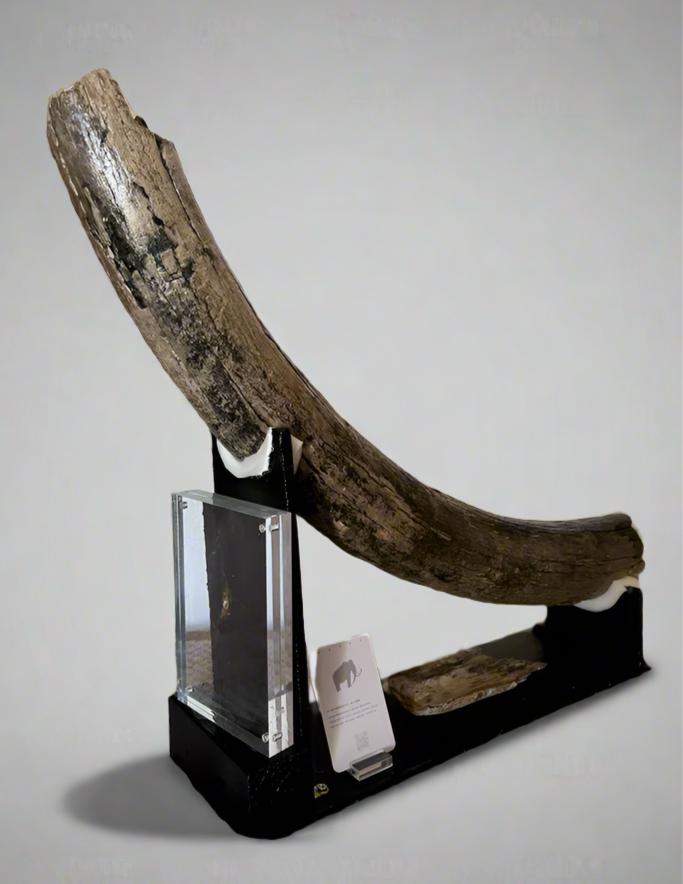
Woolly Mammoth (Mammuthus primigenius) Tusk Bark
Pleistocene-epoch
c. 30,000-50,000 years old

A section of Woolly Mammoth tusk, purchased as a child from David at Collectors' cabin, Dufftown, over 15 years ago.
One of my longest owned fossils, and still on display today.
ICE AGE FOSSILS - THE MUSEUM
Woolly mammoth (Mammuthus primigenius) Majority Tusk
Mannheim, Germany.
Ice age gravel deposits
Pleistocene-epoch
c.30,000-50,000 years old

Excavated from Pleistocene-age gravel pits in Mannhiem, Germany, this Majority tusk section has beautiful natural caramel tones and a commanding presence. The tusk has been professionally conserved with paraloid- B72 with no restoration,

ICE AGE FOSSILS - THE MUSEUM
Fragment of Mammoth Vertebra (Mammuthus)
Italy
Pleistocene-epoch
c.30,000-1,000,000 years old
Ex D.H Collection

This fragmentary vertebra originates from a Pleistocene-era mammoth, a member of the genus Mammuthus, the iconic Ice Age proboscideans that roamed Europe, Asia, and North America. Mammoths were among the largest terrestrial mammals of their time, with complex skeletal structures adapted to support their immense size.
PLANT FOSSILS

PLANT FOSSILS - THE MUSEUM
Seed Fern (sp. Pecopteris)
Mazon Creek, Illinois, USA
Carboniferous period
c.300 million years old
Ex D.H Collection

Fossilized leaf of a Carboniferous seed fern, preserved in absolutely remarkable detail. Over 300 million years old, it captures the intricate veining, texture and leaf structure of these ancient swamp forest plants.

PLANT FOSSILS - THE MUSEUM
Seal tree (sp. Sigillaria)
Palo Pinto County, Texas, USA.
Lower Pennsylvanian, Strawn group, Millsap Lake Foundation
Carboniferous Period
c.300 million years old
Ex D.H Collection

Fossilized trunk impression of the extinct Seal Tree (Sigillaria), showing small circular leaf scars arranged in a natural pattern along the bark. Preserved over 300 million years, these markings capture the structure of this Carboniferous forest giant that thrived before the dinosaurs.

PLANT FOSSILS - THE MUSEUM
Stigmaria (Lycopsid Root Fossil)
Yorkshire Coal Measures, England
Carboniferous Period
c.300 million years ago
Ex D.H Collection

A section of Stigmaria, the branching root system of lycopsid trees such as Sigillaria. The round, thick cylindrical fossil displays the characteristic circular rootlet scars, which anchored the tree in ancient coal-forming swamps. Stigmaria fossils provide a unique glimpse into the underground structures of some of the tallest plants of the Carboniferous forests.

FOSSIL PLANTS - THE MUSEUM
Petrified reed (sp. Calamites)
Graham Formation, Cisco Group, Young County, Texas, USA
Late Carboniferous
c.305–298 million years ago
Ex D.H Collection

Petrified stem of a giant Carboniferous reed (Calamites), preserved in great detail with its segmented, ribbed structure. Over 300 million years old, it represents one of the towering plants that thrived in ancient swamp forests of todays America.

FOSSIL PLANTS - THE MUSEUM
Petrified reed (sp. Calamites) (Horsetail Fossil)
Yorkshire Coal Measures, England
Carboniferous-Permian Period
c.300 million years ago
Ex D.H Collection

Another fossilized section of Calamites, this specimen preserves a sizeable length of the segmented stem structure, characteristic of these ancient plants, which could grow over 20 meters tall in swampy coal forests. Its ribbed, jointed form provides insight into the growth patterns of some of the Earth’s earliest forest giants.

MARINE INVERTEBRATES - THE MUSEUM
Brachiopods (sp. Terebratula Dutempleana)
Collected personally by David many years ago
Upper Albian, Red chalk,Hunstanton, Norfolk.
C. 100-105 million years old
Ex D.H Collection

These two specimens of Terebratula dutempleana come from the famous Red Chalk of Hunstanton, a site renowned for its mid-Cretaceous fossils. Both well-preserved examples of a brachiopod, a marine invertebrate that lived as a stationary filter-feeder in the shallow seas of Early Cretaceous Europe, during the time of the dinosaurs over 100 million years ago.

MARINE INVERTEBRATES - THE MUSEUM
Trilobites (sp. Phacops)
Wenlock shale, Horderley, Shropshire
UK
Silurian Period
c.430 million years old
Ex D.H Collection

These specimens of Phacops trilobites come from the Wenlock Shale of Horderley, a site renowned for its Silurian fossils (~430 million years old). Trilobites were marine arthropods that thrived in the ancient seas, leaving behind not only their distinctive shells but sometimes the tracks of their movements across the seafloor.

MARINE INVERTEBRATES - THE MUSEUM
Trilobites (sp. Onnia Gracilis)
Builth Wells, Radnorshire, Wales
Ordovician period, Caradoc series
c.450 million years ago
Ex D.H Collection

These impressions of the cephalon (head) and pygidium (tail) of Onnia gracilis come from the Caradoc beds of Builth Wells, a classic British Ordovician locality. Onnia was a marine trilobite that lived on the ancient sea floor over 450 million years ago, long before dinosaurs or even land plants evolved.
Preserved as natural prints in shale, this specimen offers a rare glimpse into one of the earliest complex marine ecosystems of the Paleozoic era. It connects us directly to a time when Wales lay beneath a warm, tropical ocean teeming with trilobites and other early marine life.

MARINE INVERTEBRATES - THE MUSEUM
Fossil Starfish mortality bed (Sinosura kelheimense)
Solnhofen Limestone, Heinheim, Germany
Late Jurassic, Kimmeridgian Stage
Collected: November 2009
c.150 million years old.

This exceptionally preserved fossil starfish bed originates from the world-renowned Solnhofen Limestone of southern Germany, a deposit celebrated for its remarkable conservation of delicate marine life. During the Late Jurassic, the region was a shallow, tropical lagoon, allowing for fine sedimentation that preserved fragile organisms in extraordinary detail.
