Collectors' Cabin
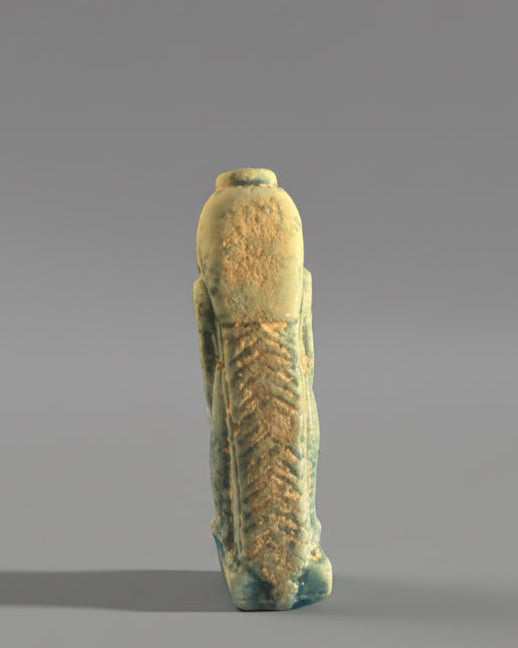
Ancient Egyptian Faience Amulet of Tawaret, c.1550-600 BC, Egypt
Ancient Egyptian Faience Amulet of Tawaret, c.1550-600 BC, Egypt
Couldn't load pickup availability
This item is now Sold.
This exquisite ancient Egyptian faience amulet represents Tawaret (also Taweret, Tauret), the protective goddess of childbirth, fertility, and the safeguarding of women, children, and the vulnerable. Dated to New Kingdom- Late Period Egypt (circa 1550–600 BC), the figure is executed in vibrant blue-green glazed faience, a color symbolic of the fertility of the Nile and the goddess’s life-giving powers.
Tawaret’s distinctive composite form combines the feet of a lioness, the spine and tail of a crocodile, the breasts and rounded belly of a pregnant woman, and the head of a hippopotamus — blending the dangerous and the protective into a single potent symbol. In front of her legs are a pair of sa-symbols, the hieroglyphic loops for protection, which were commonly used as amulets to safeguard the wearer or household. A small discoid headdress crowns her head, emphasizing her divine status.
Please note: We photographed the amulet under varying intensities of natural light to best capture its true coloration:
Under lower light, the faience naturally appears a deeper green, whereas in bright natural light it reveals a luminous, almost teal-blue glow. This optical variability aligns with the known properties of ancient Egyptian faience, whose silica-based vitreous glaze scatters light depending on angle and intensity.
Studies (e.g., Nicholson & Shaw, Ancient Egyptian Materials and Technology, 2000) note that these shifts, along with areas of differential surface gloss, are typical of long-term burial and handling, reflecting both original firing and natural wear over millennia.
Small and portable, this amulet would have been worn or displayed in a domestic setting as a protective charm, linking daily life with spiritual safeguarding. The well-preserved glaze and subtly mottled surfaces reflect centuries of handling and ritual reverence, highlighting the object’s enduring role as a personal talisman.
Specimen Details:
Age / Period: New Kingdom- Late Period (c. 1550-600 BC)
Origin: Egypt, Africa
Material: Glazed faience, blue-green pigment
Technique: Moulded faience with painted or inlaid pigment
Dimensions: 4.8cm H (overall) x 1cm W x 2cm D (base)
Condition: Preserved with natural patina and subtle glaze variations
Function: Protective amulet; designed for personal wear or household display
Comparative Specimens:
Objects of similar size, iconography, and function are found in museum collections of Ancient Egyptology, demonstrating the widespread devotion to Tawaret as a guardian of women and children.
Comparable Specimen 1- (closely matched worn example) https://www.britishmuseum.org/collection/object/X__4056
Comparable Specimen 2- (parallel iconography; different composition material) https://www.britishmuseum.org/collection/object/Y_EA35700
Share