Collectors' Cabin
Ancient Roman Phallic Amulet (Fascinus). 100-300AD, Roman Britain
Ancient Roman Phallic Amulet (Fascinus). 100-300AD, Roman Britain
Couldn't load pickup availability
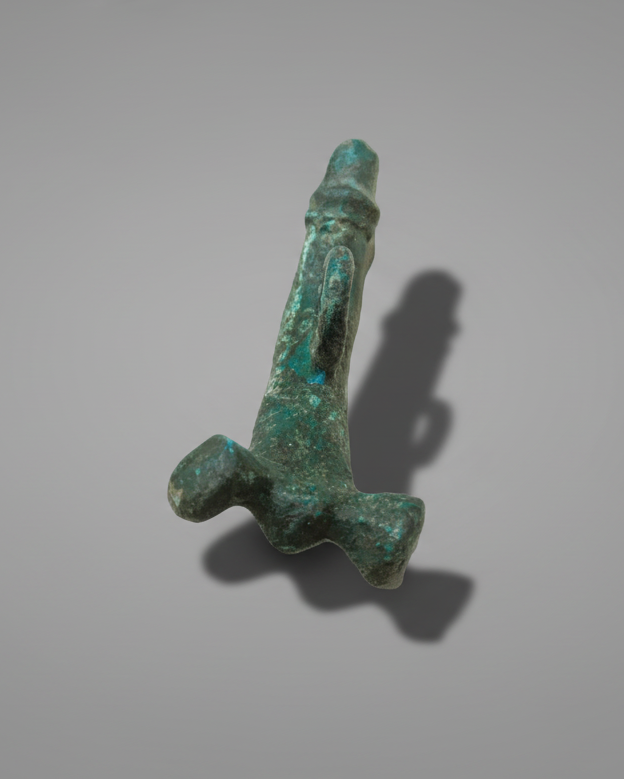
An authentic Roman phallic amulet (fascinus), dating to Roman Britain (2nd–3rd century AD, c. AD 120–300). Featuring a boldly cast erect phallus with testicles and an integral suspension loop, such pendants were widely used across the Roman Empire as protective charms against the evil eye and misfortune. Worn by adults and children alike, they were commonly associated with good fortune, fertility, and apotropaic (evil-warding) symbolism.
The strong, three-dimensional form of the phallus, carefully cast with clear anatomical detail, reflects the Roman belief in the power of visual imagery to ward off harm. The bronze has developed a striking, almost green patina with subtle brown undertones, preserving both the texture and character of the ancient object while highlighting its age and journey through time.
Specimen Details:
Specimen: Phallic Amulet (Fascinus)
Culture: Roman
Age/Era: 1st–3rd Century AD,
Material: Copper alloy (bronze)
Form: Erect phallus with integral suspension loop
Length: 4.5 cm
Findspot: England, Roman Britain
Condition: Complete; natural ancient patina; mostly undecorated apart from a grooved tip.
Comparable Recorded Finds:
Comparable examples with closely aligned typology and dimensions (within 3 mm) are recorded in the ‘Portable Antiquities Scheme’ by the British Museum:
(Click “PAS FindID...” to view the specimen or copy the link provided below)
Reference Specimen 1: PAS FindID 798875 - (Lincolnshire, dated c.120-300AD) https://finds.org.uk/database/artefacts/record/id/798875
Reference specimen 2: PAS FindID 1144382 — (Oxfordshire, dated c120-300AD. Parallel form, however poor grade of preservation): https://finds.org.uk/database/artefacts/record/id/1144382
These parallels support the typological authenticity of this amulet as a Roman period find from Britain.
Share