Collectors' Cabin
Ancient Roman Bronze Signet Ring Hand-Engraved with Horse and Rider, 100-300AD. England, Roman Britain.
Ancient Roman Bronze Signet Ring Hand-Engraved with Horse and Rider, 100-300AD. England, Roman Britain.
Couldn't load pickup availability
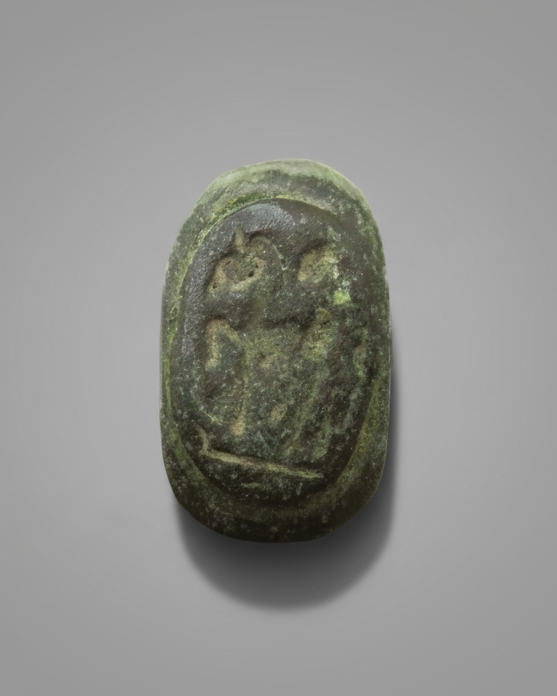
This ancient bronze signet ring represents a genuine personal object of daily life from Roman Britain. The bezel is engraved with a depiction of a horse and rider, a motif widely attested in Roman provincial contexts and commonly associated with mobility, cavalry service, travel, and personal identity.
An exceptional example of Romano-British craftsmanship, it remains remarkably preserved, with its original form intact and the hand-carved bezel clearly legible. Its surface displays a rich, natural patina, varying from deep brown to subtle green, reflecting centuries spent in the acidic soils of Britain.
The horse-and-rider motif seen on this Roman bronze seal ring echoes a visual language used across Roman imperial art, most famously in the surviving equestrian statue of Emperor Marcus Aurelius c.175 A.D (please see image 5 for comparison). The horse’s pose — one leg raised, the other firmly grounded — was a deliberate compositional choice, symbolising controlled motion, authority, and restraint rather than aggression.
In Roman culture, such imagery conveyed imperium and virtus: power exercised calmly, guided by discipline and moral strength.
The ring displays characteristic features of ancient manufacture. The engraved image appears to have been carved directly into the bezel after casting, with tool marks and uneven line depth consistent with hand engraving rather than moulded decoration.
The engraving includes a carved ground line beneath the horse’s hooves — a classical convention used in Roman glyptic art to anchor figures in controlled motion.
The hoop is slightly irregular and visibly joined, suggesting a cast ring blank that was subsequently shaped and adjusted by hand (a practical approach typical of Roman bronze jewellery).
The small internal diameter indicates the ring was likely worn by a woman, a youth, or as a little-finger ring by a smaller man. In the Roman world, signet rings were not merely decorative but functional, used to seal correspondence and mark ownership, serving as a personal emblem of the wearer.
Bronze signet rings of this type were common among individuals of modest means, particularly in the western provinces of the empire, including Roman Britain and Gaul. Unlike elite gold or gemstone rings, such objects reflect the material culture of ordinary Roman lives —every day items carried, worn, and used over many years.
Specimen Details:
Origin: Roman Britain (England, United Kingdom), Western Roman Empire; acquired from an old UK collection.
Era/age: Circa 1st–3rd century AD, approx. 1,725–2,024 years old
Material: Bronze
Sizing:
Internal diameter approx. 17mm
Total approx 20mm x 20mm
Signet bezel 10mm thick
Band tapers from 7mm to 2mm wide, approx 1.5mm thick.
Modern UK ring size: Approx. J½–K
Preserved with a stable patina and honest surface wear, this ring offers a tangible connection to everyday identity, movement, and communication within the Roman Empire.
Share