Collectors' Cabin
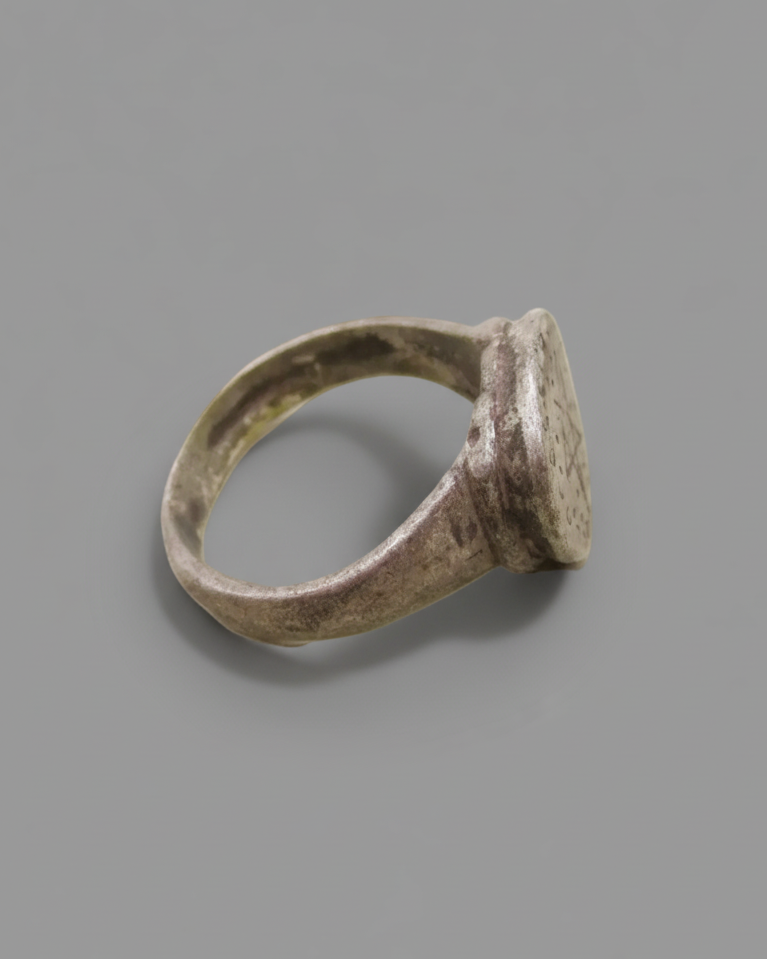
Medieval Silver Apotropaic Ring Depicting a Pentagram. Hand-Engraved. 975–1150AD, Europe.
Medieval Silver Apotropaic Ring Depicting a Pentagram. Hand-Engraved. 975–1150AD, Europe.
Couldn't load pickup availability
This item is now Sold.
Discover a truly exceptional piece of medieval craftsmanship and symbolism: a silver pentagram ring, dating from late 10th-11th century Europe (approximately 875-1,050 years ago).
This medieval silver ring was likely worn as a personal talisman, deliberately imbued with protective “magical” power by its original owner.
Carefully hand-engraved, this rare ring features a lightly incised pentagram on the bezel, with characteristic irregularities including uneven lines, slight overshooting, and one point that does not fully meet — hallmarks of authentic medieval handcrafting. Surrounding the star are small circular punch marks along the bezel, with three additional punch marks positioned between each point of the star, consistent with medieval talismanic practice.
Along the outer face of the bezel, the design features a small indented line and four small punch marks along the side where the band meets the bezel. These subtle details reflect not only the craftsmanship of the medieval maker, but a symbolic use of numbers and shapes for spiritual protection, ‘magic’ and apotropaic purposes, a common belief in the Middle Ages, enhancing its role as a talisman in daily life.
In the medieval worldview, symbols like the pentagram were believed to ward off misfortune, illness, and spiritual harm, blending faith and everyday ritual. Yet the design itself is deeply rooted in Christian symbolism: historically the five points of the pentagram represent the five wounds of Christ, while the three punch marks between each point may reference the Holy Trinity. Centuries before this ring was worn, the pentagram carried spiritual meaning within Christianity, and by the 10th-11th century, medieval wearers harnessed that symbolism in a practical, almost magical way, merging devotion with personal protection.
Social and Material Context:
Unlike the majority of documented medieval pentagram rings, which are typically made from bronze or copper alloys, this ring is crafted from solid silver alloy. The choice of silver suggests that it likely belonged to a wealthier individual or someone of higher social status, who could afford precious metal for personal protective jewellery. This elevates both the rarity and significance of the piece, as it combines applied spiritual symbolism with valuable material, highlighting its importance to the original wearer.
A similar example of this type of ring is catalogued and documented by the British Museum: a medieval finger-ring from Kerch, Crimea, featuring an engraved pentagram with punched dots around the bezel, closely matching the style and symbolic features of this piece. This comparison highlights the ring’s historic use in Eastern Europe and its connection to medieval protective and devotional practices. View the British Museum record here : https://www.britishmuseum.org/collection/object/H_1923-0716-70
At around 1000 years old, this magical ring is a tangible link to medieval spiritual, magical and protective practices, embodying the beliefs, symbolism, and craftsmanship of its time.
Specimen Details:
Age/Period: 900-1100 AD, late 10-11th century, (circa 875-1,050 years ago)
Origin: Europe, likely Eastern Europe based on similar documented finds noted.
Material: Solid Medieval Silver (medieval alloy-silver with impurities consistent with age)
Condition: Worn with natural patina; engraving intact and clearly legible
Dimensions: Internal band width 1.8cm
Provenance: Ex pre 1990s European collection, then part of a respected British collection until acquired by Collectors’ Cabin.
This ring is more than a piece of medieval jewellery; it is a museum-quality talisman, combining rare craftsmanship, historical authenticity, and deeply symbolic design. Its unique combination of magical apotropaic symbolism and solid hand forged silver construction makes it an exceptional highlight for any serious collection of medieval artifacts.
Share