Taxes included.
This item is now sold.
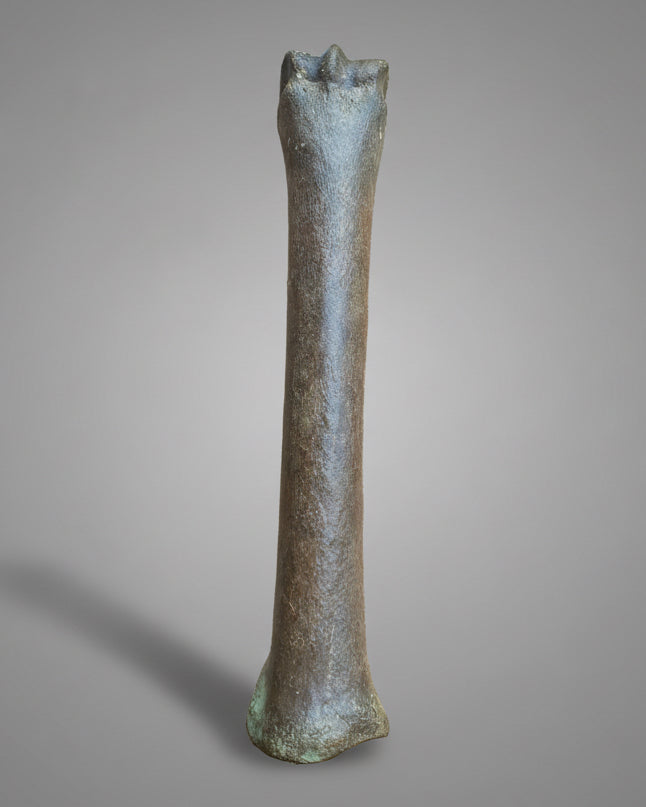
This incredibly well-preserved horse metatarsal exhibits three deep incised cuts, consistent with butchery by early humans. The placement and depth of the marks indicate they were made with a sharp tool, while soft tissue was still attached, likely during skinning for meat and hide.
This exceptionally rare specimen provides direct evidence of human subsistence practices in late Pleistocene Central Europe, illustrating the interaction between early hunter-gatherers and large Ice Age fauna. Humans at this time were highly opportunistic, consuming any animal that could provide food, and this bone preserves evidence of that survival strategy.
Recovered from Upper Vistula River deposits, the bone contributes valuable insight into human behavior, tool use, and Ice Age ecology. The preservation of the bone itself is outstanding, with both proximal ends of the metatarsal perfectly preserved, and overall the specimen remains fully intact.
Its preservation and the clarity of the cut marks make it a significant artifact suitable for museum display or scholarly study.
Specimen Details
Species: Equus ferus (Wild Horse)
Element: Metatarsal (hind limb)
Provenance: Upper Vistula River, Poland
Age: Pleistocene Epoch, c. 28,000–13,000 BC
Dimensions: 28cm L
Weight: 374 G
Preservation: Well-preserved bone, intact proximal ends and deep brown caramel patina, with three deep incised cuts
Butchery Evidence: Cut marks made while soft tissue was present, likely from skinning
Significance: Rare example of human-animal interaction in late Pleistocene Central Europe; illustrates opportunistic subsistence practices of anatomically modern humans