Collectors' Cabin
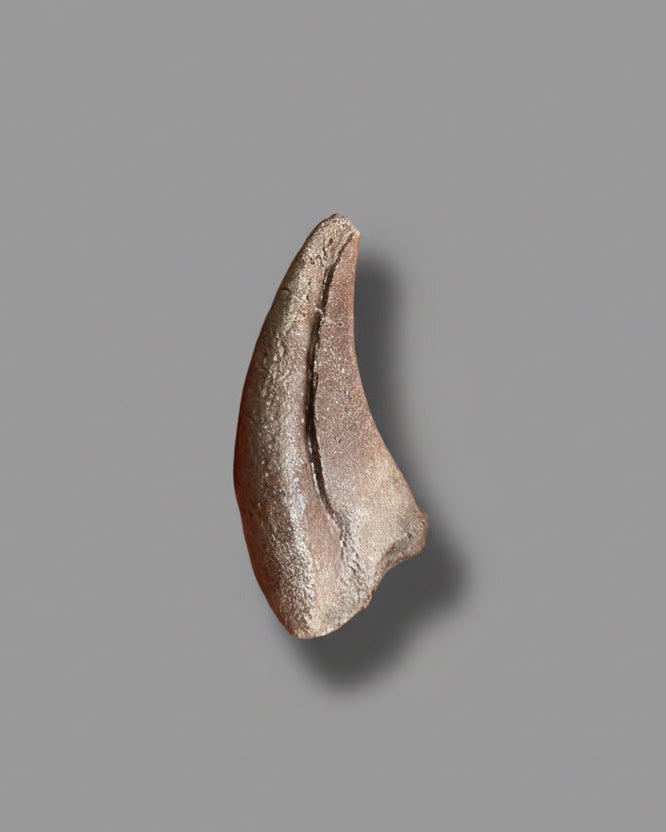
Sauropod Dinosaur Pedal Claw. Jurassic. Isalo III Formation, Madagascar
Sauropod Dinosaur Pedal Claw. Jurassic. Isalo III Formation, Madagascar
Couldn't load pickup availability
This exceptional sauropod dinosaur pedal claw originates from the renowned Isalo III Formation of Madagascar, celebrated for its well-preserved Middle Jurassic dinosaur remains.
This beautiful fossil comes from one of the famous long-necked dinosaurs that genuinely lived during the Jurassic — the very type of creatures that inspired the sauropods in the Jurassic Park movies. Holding it gives a direct connection to these ancient giants and the ancient landscapes they once roamed.
Measuring approximately 5.5 cm in length, 3.5 cm in height, and 2 cm in proximal width, the claw exhibits the robust, gently recurved morphology characteristic of a weight-bearing left pedal ungual from a small to medium-sized sauropod of the Jurassic Eusauropoda group , offering a rare and detailed glimpse into the anatomy of Madagascar’s iconic island dinosaurs.
Preservation is excellent, including a fully intact proximal articulating surface and a prominent lateral blood groove, highlighting fine anatomical detail that rarely survives millions of years. Its natural brown-caramel coloration, subtle patina, sweeping curvature, and beautifully preserved bone texture showcase the intricate structure and dynamic character of the original bone. The specimen is complete and unrestored, with only a minor naturally occurring tip crack professionally consolidated to museum standards.
Anatomically, this claw represents a robust partially weight bearing pedal ungual from the left foot of a small to medium-sized eusauropod. Its recurved and sturdy form reflects adaptations for supporting substantial body mass while maintaining stability and mobility across varied terrain. The claw exhibits a subtle inward curve toward the body’s midline, curving to the right, which identifies it as originating from the left foot. In sauropods, pedal unguals naturally curve toward the center of the body, allowing paleontologists to determine laterality even from isolated claws.
Morphologically, it aligns with Middle Jurassic Isalo IIIa sauropods, notably Lapparentosaurus and Narindasaurus. While isolated claws cannot be confidently assigned to a specific genus, this specimen represents precisely the type of pedal anatomy associated with these Madagascan sauropods.
Specimens of this quality—complete, anatomically informative, and with secure Madagascan provenance—are rare on the private market, making this claw a standout for serious collectors, educational displays, or museum-style presentation.
Origin Information
Origin: Isalo III Formation (likely IIIa), Madagascar
Age: Middle Jurassic (~168–166 million years ago)
Palaeoenvironment: At the time, Madagascar was an isolated island within the southern supercontinent Gondwana, fostering smaller, endemic sauropod species. These herbivores coexisted with theropods and other vertebrates, and their curved pedal claws reflect adaptations for balance, support, and locomotion across river valleys, open woodlands, and other landscapes of this island ecosystem.
Based on preservation, intact proximal surface, and depositional context, this claw is consistent with material from the lower member of Isalo III (Subunit IIIa, Bajocian).
Product Specifications
Specimen Type: Pedal ungual (toe claw), Sauropoda – Eusauropoda group (likely digit I of the left foot)
Size: 5.5cm L × 3.5 cm H × 2 cm W (at proximal end).
Condition: Original and unrestored; intact proximal articulating surface; distinct blood groove; very minor natural hairline tip cracks professionally stabilized and consolidated; excellent natural patina; beautifully preserved bone texture, conserved to museum standard
Presentation: Supplied in a premium display case
Certificate of Authenticity: Included
A rare and exquisitely preserved Middle Jurassic sauropod claw, offered exclusively by Collector’s Cabin.
All serious inquiries are welcome — contact collectorscabinltd@gmail.com or via the Contact link on our main menu.
Specimens are photographed in natural light for accuracy; minor colour variation may occur due to screen settings.
Share