Taxes included.
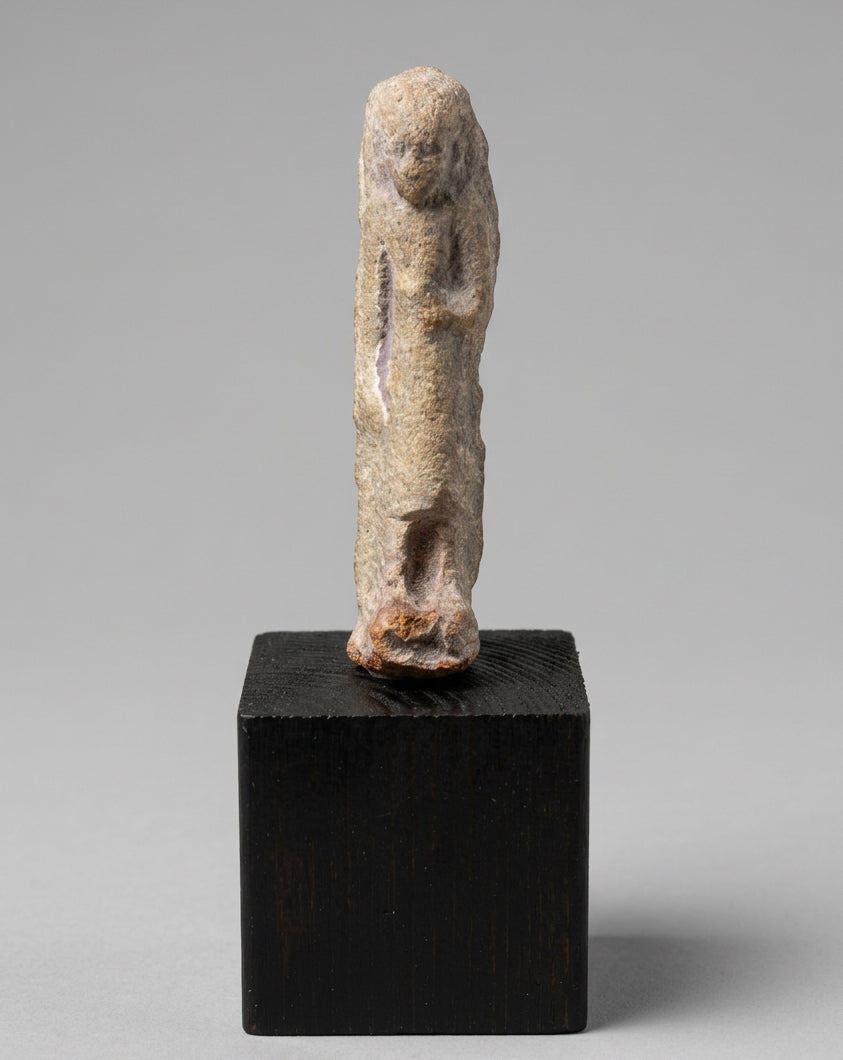
A rare ancient Egyptian terracotta overseer shabti, dating to the Third Intermediate Period, circa 1069-664 BC.
The figure is depicted wearing a traditional kilt and a long descending wig, with one arm resting alongside the body and the other positioned across the chest, holding a flail.
The shabti is mould-made with a flat reverse and carefully modelled three-dimensional frontal features. The surface retains traces of original white and dark blue pigment within the recessed and contoured details, along with traces of a bright turquoise glaze on underside of the base, providing evidence of its original decoration. (please see image 5)
The distinctive clothing and supervisory attributes distinguish it from the more familiar mummiform worker shabtis. Overseer shabtis represented the officials responsible for organising and supervising groups of funerary workers, and are consequently relatively scarce in comparison.
Pottery overseers of this general form are documented from the Third Intermediate Period, including examples attributed to the 21st and 22nd Dynasties.
A custom display stand with a base measuring 44 mm tall x 41mm wide is included with the specimen.
Specimen details:
Origin: Egypt, North Africa
Period: Third Intermediate Period (attributed to dynasty 21-22)
Composition: Terracotta (Clay)
Dimensions: Overall display height 113mm (11.3cm); Shabti 73mm x 18mm x 20mm.
Condition: Fine condition, structurally Intact with no repairs. Fine raised details slighly rounded in age. Traces of surviving white and dark blue pigmentation, particularly within recesses and under base. Please note the piece does not stand unaided.
Provenance: Formerly in a private English family collection of Egyptian antiquities, formed during the early-mid 20th century.
Later inherited by C.K, West Midlands, England. Acquired from the aforementioned via private auction 2026.
Comparable specimens (reference)
Museum number EA71058 - The British Museum
Object Number 1922.241 - Toledo Museum of Art