1
/
of
6
Collectors' Cabin
Ancient Egyptian Clay Shabti Mounted on a Hardwood Base - Third Intermediate Period, c. 1069–664 BC
Ancient Egyptian Clay Shabti Mounted on a Hardwood Base - Third Intermediate Period, c. 1069–664 BC
Regular price
£110.00 GBP
Regular price
Sale price
£110.00 GBP
Taxes included.
Quantity
Couldn't load pickup availability
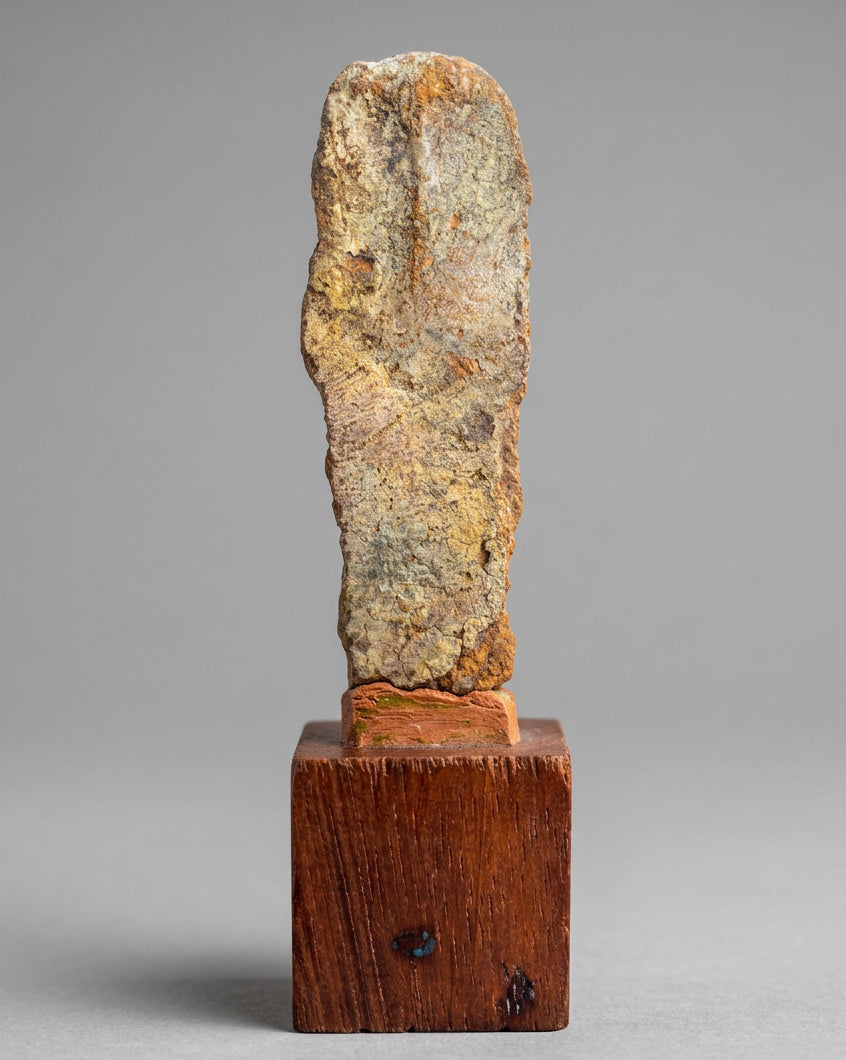
An ancient Egyptian terracotta shabti, dating to the Third Intermediate Period, c. 1069–664 BC.
The shabti is mould-made in the traditional upright mummiform posture, featuring simplified crossed arms over the chest and a heavy, plain tripartite wig framing the face. The softly modelled facial features remain discernible, with the eyes, nose, and mouth still visible.
The frontal surface bears traces of a white base pigment along with areas of darker pigmented details, retained within the crevices.
The frontal surface bears traces of a white base pigment along with areas of darker pigmented details, retained within the crevices.
The reverse is characteristically flat and devoid of a dorsal pillar, reflecting the open-faced, single-mould production techniques employed during this era. The surface of the reverse bears traces of white pigmentation, along with faint fingerprint impressions, likely from the ancient Egyptian who crafted the piece over 2,600 years ago.
Formed from low-fired Nile silt clay, the surface exhibits an earthy, weathered patina with natural mineral deposits and age-related abrasion consistent with long-term burial. Uninscribed and compactly proportioned, this anepigraphic example represents a classic worker shabti, produced in large numbers to serve as a magical substitute for the deceased and undertake agricultural labour in the afterlife.
Formed from low-fired Nile silt clay, the surface exhibits an earthy, weathered patina with natural mineral deposits and age-related abrasion consistent with long-term burial. Uninscribed and compactly proportioned, this anepigraphic example represents a classic worker shabti, produced in large numbers to serve as a magical substitute for the deceased and undertake agricultural labour in the afterlife.
The lower extremity terminates cleanly without a projecting foot plinth, mounted securely onto its antique display block (measuring 25mm tall and 25mm wide.
Specimen Details:
Origin: Egypt, North Africa
Period: Third Intermediate Period, c. 1069-664 BC
Dimensions: 83 mm total display height with stand; Shabti 57 mm tall × 20 mm wide
Condition: Fair to fine condition for type, with no modern restoration. Softening and surface wear to the mould-formed features consistent with low-fired clay and long-term burial. Minor edge wear and expected loss to the lower base where permanently mounted.
Provenance: Formerly in a private English family collection of Egyptian antiquities, formed during the early-mid 20th century.
Later inherited by Mr C.K, West Midlands, England. Acquired from the aforementioned via private auction 2026.
Later inherited by Mr C.K, West Midlands, England. Acquired from the aforementioned via private auction 2026.
Comparable specimens (reference)
Accession number 60.34.12 – National Museums Liverpool, World Museum
Share