Taxes included.
Free Uk postage included with this item.
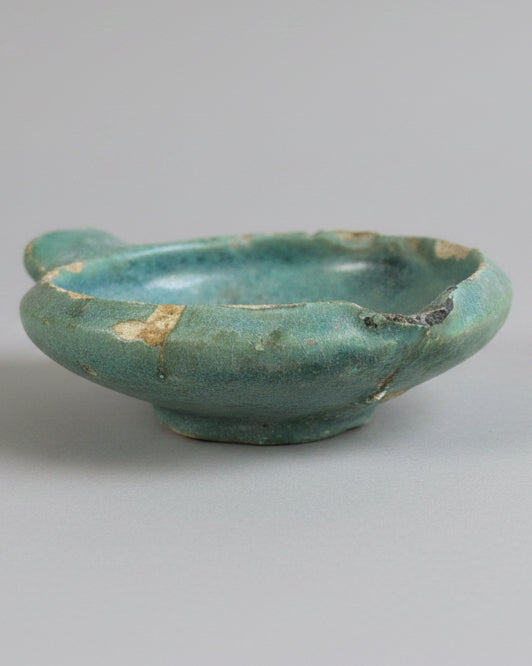
A finely modelled earthenware oil lamp from the early Islamic world, dating to the 8th–9th century AD. Formed in buff earthenware and finished with a striking blue-green glazed surface.
The lamp is circular in form with an incurving rim, flat base, and a single applied handle set opposite an elongated spout (wick nozzle). The open reservoir design is characteristic of early Islamic lighting vessels, intended for use with olive oil and a textile wick.
The vivid turquoise glaze is typical of early Mesopotamian copper-based glazes, a hallmark of workshops operating in regions of modern-day Iraq during the formative Islamic period. The surface retains a rich, mineral-like depth of colour, with natural variation consistent with ancient kiln firing processes.
Comparable examples are held in major institutional collections, including the Metropolitan Museum of Art (Object Number: 32.150.107) and The British Museum (Museum number: OA+.2069).
According to the curatorial notes of the British Museum, similar lamps were found in the area of a Parthian cemetery below Islamic houses. It is understood that these levels were rather mixed, reflecting the long occupational history of Mesopotamian urban centres.
Specimen Details:
Specimen: Oil Lamp with Open Reservoir
Age: 8th-9th century, c.750-900 AD
Period: Early Medieval (Early Islamic)
Composition: Earthenware, buff body (Pottery/Ceramic)
Technique: Glazed (blue-green glazed)
Dimensions: 86mm diameter (99mm including handle), 28mm tall
Weight: approx. 76g
Condition: The glaze itself still overwhelmingly intact and vibrant, with only small areas of abrasion the edges. The lamp shows evidence of a historical repair around the wick spout, likely using shellac as an adhesive, consistent with late 18th to early 20th century restoration practices. Aside from the small repair the specimen remains intact and in an exceptional state of preservation overall.
Provenance: From an old Pembrokeshire based private collection (C.S). Ex London based collection c.1960s.