Collectors' Cabin
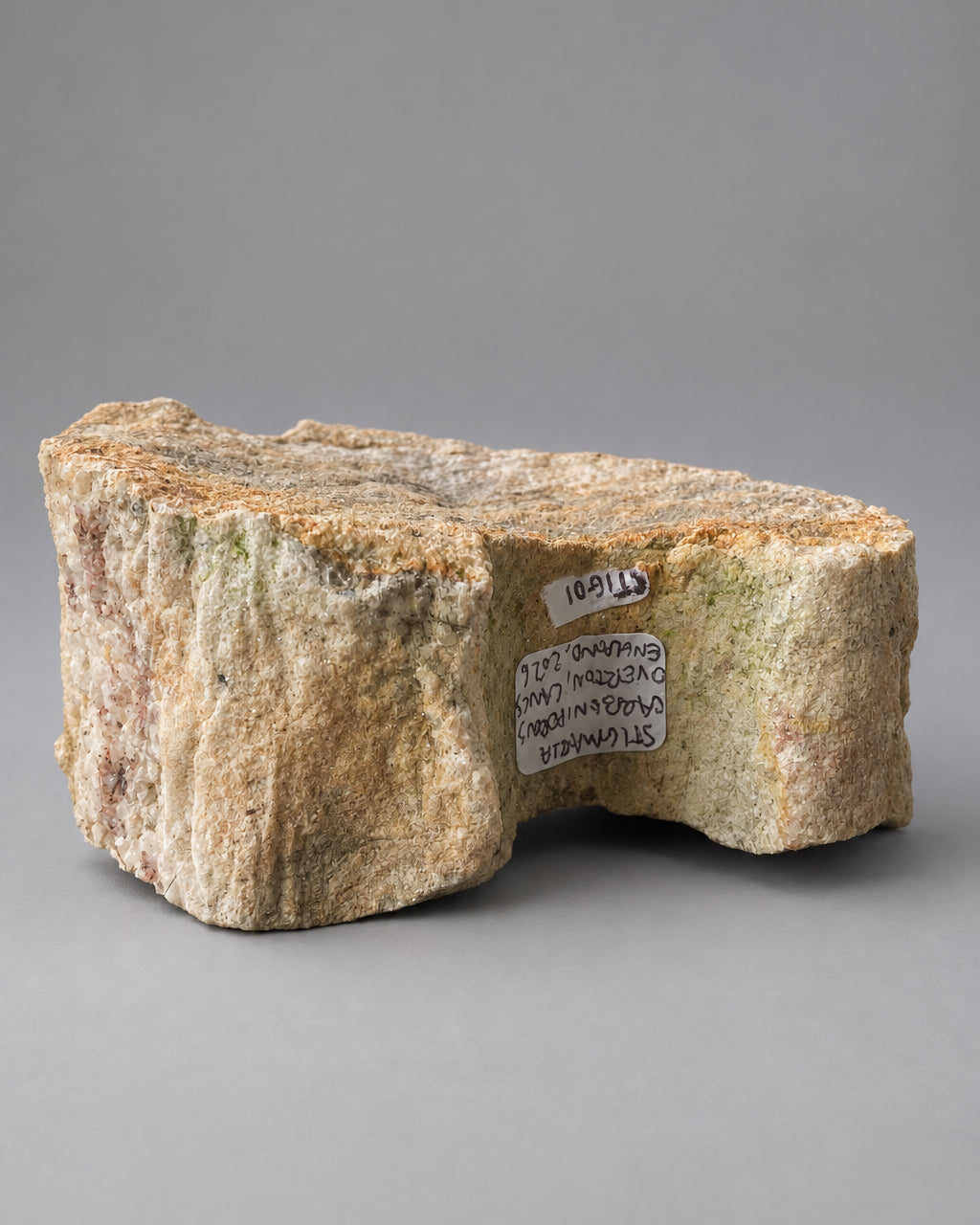
Section of Fossilised Lycopod Tree Root (Stigmaria) - Millstone Grit - Carboniferous Period - Overton, Lancashire, England. (A)
Section of Fossilised Lycopod Tree Root (Stigmaria) - Millstone Grit - Carboniferous Period - Overton, Lancashire, England. (A)
Couldn't load pickup availability
An interesting section of fossilised Stigmaria, representing part of the underground root system of a giant Carboniferous lycopod tree.
The specimen is composed entirely of coarse Millstone Grit sandstone, with abundant visible quartz grains, which has preserved and replaced the original organic structure of the root. The original plant material has been completely mineralised over geological time, leaving the characteristic form of the Stigmaria preserved in stone.
Particularly notable are the numerous small circular rootlet scars preserved across the surface. These represent the points from which the fine rootlets emerged from the main Stigmaria root, providing a distinctive feature of these ancient rooting systems.
Stigmaria was the underground rooting system of the great arborescent lycopods, including plants such as Lepidodendron and Sigillaria. These tree-like plants formed vast Carboniferous forests across what is now Britain, growing in warm, humid environments approximately 320 million years ago.
Specimen Details:
Specimen: Section of Fossilised Lycopod Tree Root (Stigmaria)
Period: Carboniferous Period, c. 359–299 million years ago
Material/Composition: Completely mineralised fossil preserved in coarse-grained sandstone (Millstone Grit)
Locality: Overton, Morcambe Bay, Lancashire, England.
Dimensions: 90mm x 60mm x 40mm
Provenance: Recovered in 2026 by a Lancashire-based collector.
Share