Collectors' Cabin
Woolly Mammoth Limb Bone (Humerus) Section - Excavated From Gravel Deposits, Berkshire, England - Late Pleistocene, c. 28,000 BC
Woolly Mammoth Limb Bone (Humerus) Section - Excavated From Gravel Deposits, Berkshire, England - Late Pleistocene, c. 28,000 BC
Couldn't load pickup availability
This extraordinary Ice Age bone, most likely a partial humerus, derives from a Mammuthus primigenius, the iconic woolly mammoth of the Late Pleistocene.
The specimen originates from gravel deposits in Berkshire, England, the specimen is estimated to be around 30,000 years old. The bone exhibits a rich, natural patina, with subtle variations in ochre, tan, and creamy ivory tones that reflect its long burial and mineralization within the Berkshire gravel pit.
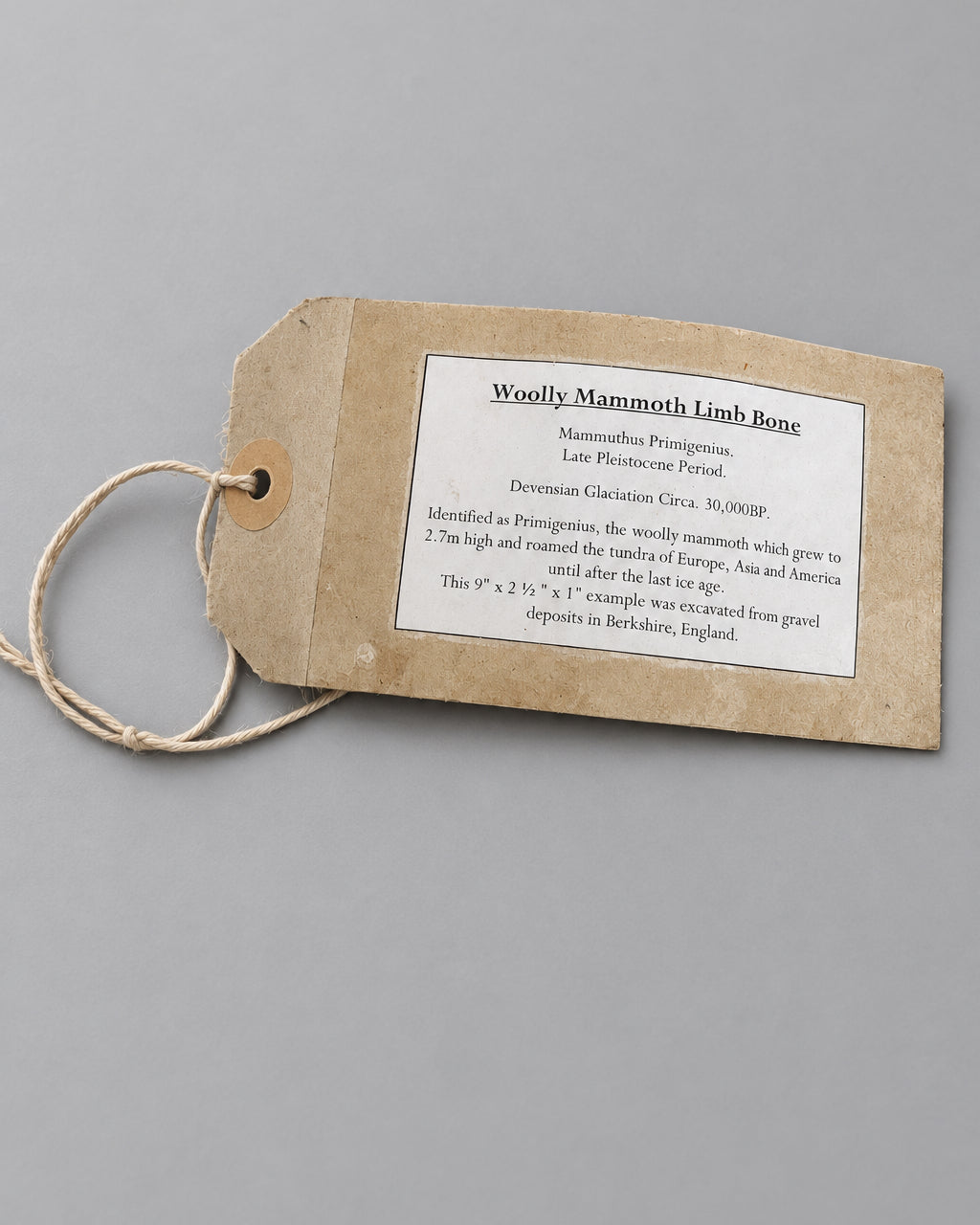
The piece is accompanied by a vintage collection label, bearing old collection number (1448/115).
Preserved with its natural curvature intact, this fossil limb bone exhibits robust cortical bone structure.The lighter, tan-coloured material making up most of the shard is the heavily mineralised, dense outer wall of the limb bone (cortical bone), which provides structural strength.
The darker interior zone is where the bone transitioned into the marrow cavity. In life, this area was filled with spongy, porous bone tissue. Because it was highly porous, mineral-rich groundwater carrying iron and manganese easily flooded this internal cavity after the mammoth died, staining the core dark brown during the fossilisation process.
The visible cross-section shows that the bone appears to have split lengthwise down the shaft right along the natural boundary where the dense outer bone meets the spongy interior.
Its aged, rough surface bears the marks of centuries spent in sediments, with gentle abrasions and textured ridges that, in our opinion, enhance its authenticity and visual appeal.
Specimen Details:
Species: Mammuthus primigenius (Woolly Mammoth)
Element: Limb bone section (Humerus)
Age: c. 28,000 BC, Late Pleistocene (~ 30,000 years old)
Origin: Excavated from Gravel Deposits in Berkshire, South Eastern England
Dimensions: 230mm x 63mm x 25mm
Morphology: Natural curvature, cross section of robust cortical bone & mineralised marrow cavity.
Provenance: Formerly in the private collection of a lady, ‘L.L’, based in Kent, South Eastern England. Likely excavated in the early-mid 20th century.
Complete with vintage collection label bearing old collection number (1448/115).
Share