Taxes included.
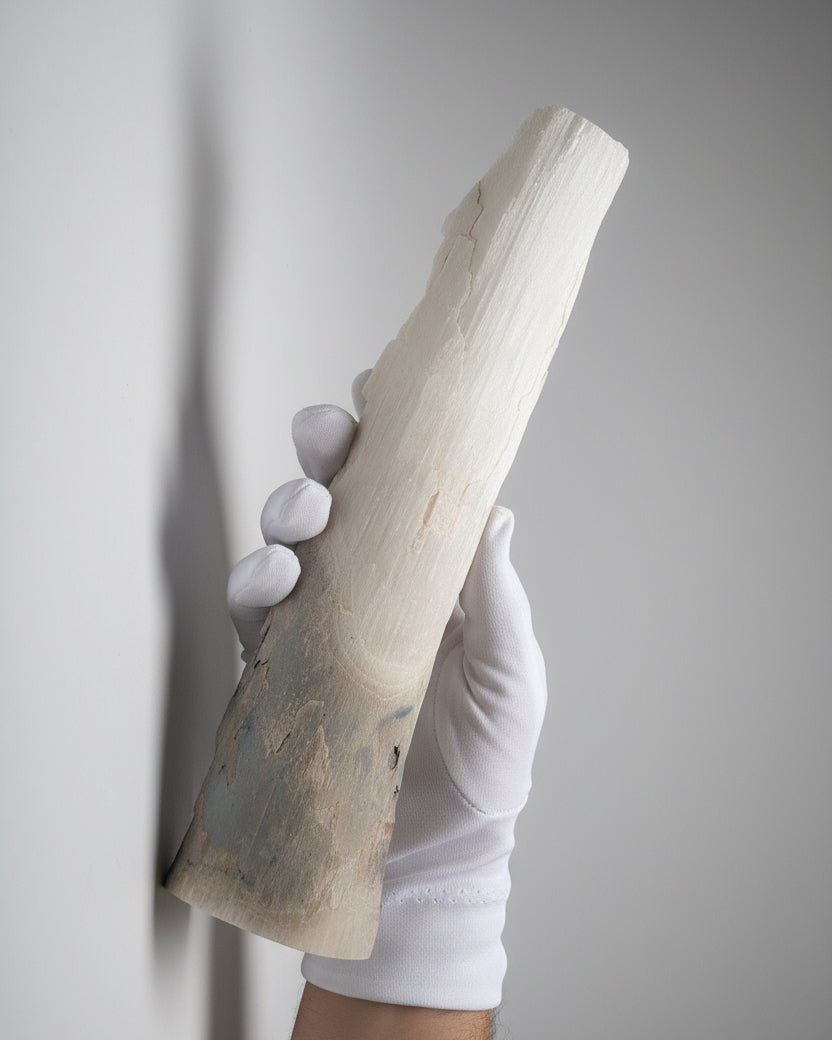
A large section of woolly mammoth tusk recovered from the permafrost of Taimyr, Siberia, one of the most significant regions in the world for Ice Age material.
Specimens from this area are typically released from the ground as ancient permafrost thaws for just a short time each year, revealing remains that have been sealed in frozen conditions since the Pleistocene.
This sizeable piece retains a strong natural curvature along its length, reflecting the spiralled growth of mammoth tusks, which developed as elongated incisor teeth over the lifetime of the animal.
Based on the form and dimensions, it likely forms the area leading up to the tip of the tusk, between the midsection and the very tip. This along with the preserved outer bark surface offers a direct insight into the anatomy of the tusk.
Of particular note is the presence of vivid blue vivianite mineralisation across both faces. This phosphate mineral forms under oxygen-poor burial conditions, where organic material interacts with iron-rich environments over extended periods. In this example, the reverse hosts fine, deep-blue crystalline growth, developed in situ over tens of thousands of years. The result is a specimen that bridges palaeontology and mineralogy — a natural record not only of the animal itself, but of the chemical environment in which it lay entombed.
The permafrost season in Siberia is brief, and material can only be collected for a few weeks each year. Combined with current regional high tensions, the availability of authentic Siberian tusk is increasingly limited, making this piece highly collectible. For this reason, Siberian material is considered much more valuable compared to specimens from other localities.
Specimen Details:
Species: Mammuthus primigenius (Woolly Mammoth)
Specimen Type: Tusk section (outer bark)
Locality: Taimyr, Siberia, Russia
Preservation: Permafrost find
Geological Age: Pleistocene Epoch (circa 30,000–50,000 years old)
Dimensions: 248 mm (L)
Weight: 110.5 g
Condition: Natural, unrestored
Mineralisation: Strong blue vivianite present on both front and reverse
Notable Features: Preserved natural curvature; intact outer bark surface; mineralogical overgrowths formed during burial
Reference: T63