Taxes included.
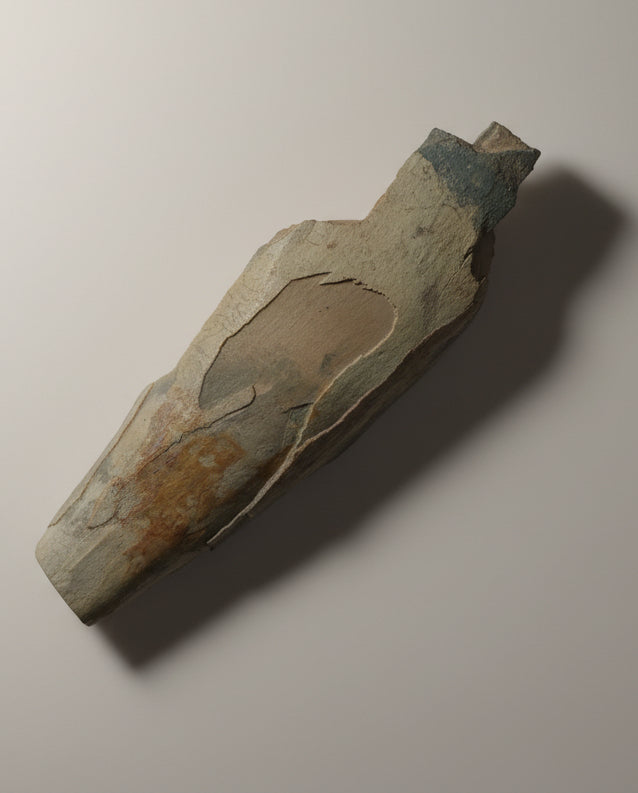
A distal (tip-end) section of woolly mammoth tusk recovered from the permafrost of Taimyr, Siberia — one of the most significant regions in the world for Ice Age material.
Specimens from this area are typically released from the ground as ancient permafrost thaws for just a short time each year, revealing remains that have been sealed in frozen conditions since the Pleistocene.
Material from this part of the tusk is much less commonly preserved, as the tip would have experienced the greatest wear during the animal’s lifetime, along with typically being most sought after section.
This beautiful tusk tip retains clear internal growth structure, with visible banding that records the incremental development of the tusk as it extended outward. This combined with the preserved ‘bark’ surface offers a direct insight into the anatomy of the tusk.
The reverse surface shows areas of blue vivianite mineralisation, formed during burial in low-oxygen, phosphate-rich conditions. This mineral develops over extended periods through the interaction of organic material and iron, adding both visual contrast and geological significance to the specimen.
The permafrost season in Siberia is brief, and material can only be collected for a few weeks each year. Combined with current regional high tensions, the availability of authentic Siberian tusk is increasingly limited, making this piece highly collectible. For this reason, Siberian material is considered much more valuable compared to specimens from other localities.
Specimen Details:
Species: Mammuthus primigenius (Woolly Mammoth)
Specimen Type: Tusk section (outer bark)
Locality: Taimyr, Siberia, Russia
Preservation: Permafrost find
Geological Age: Pleistocene Epoch (circa 30,000–50,000 years old)
Dimensions: 161 mm (L)
Weight: 95.8 g
Condition: Natural, unrestored
Mineralisation: Strong blue vivianite present on both front and reverse
Notable Features: Preserved natural curvature; intact outer bark surface; mineralogical overgrowths formed during burial
Reference: T54